

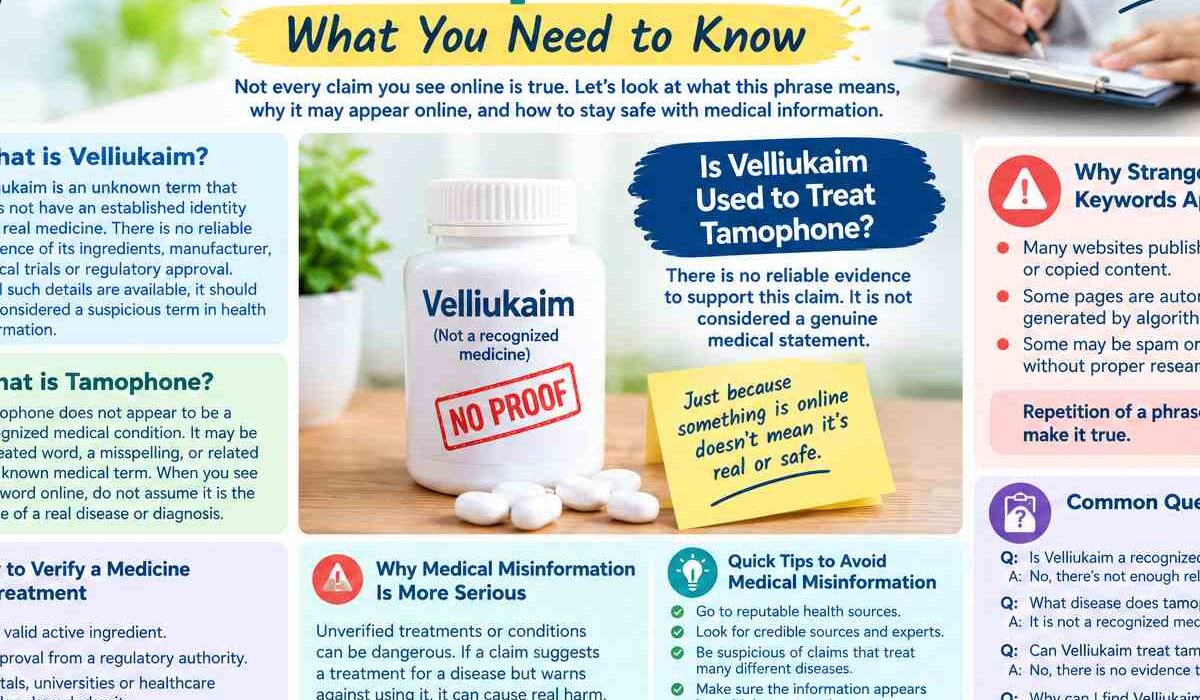
The phrase “Velliukaim used to treat tamophone” probably sounds strange and absurd. It might seem to say that one substance represents a known medicine and that another word is a known medical condition.
No widely known medical evidence verifies Velliukaim as a recognized treatment, or that tamophone is a known medical condition.
So, we must take the necessary caution to believe what we see.
This guide covers what is known and unknown about this phrase, why this phrase may have appeared online, and how you should go about reading medical-related claims online.
What Velliukaim Is:
As far as I can tell, Velliukaim is some kind of strange phrase that appears online but does not have an established meaning or identity as a known medicine within mainstream medical circles.
Some websites say Velliukaim is connected to medicine, but being present on the Internet is not an indication that it is a real medicine, an authentic treatment, or even a legitimate drug product with a recognized active formula.
If a medicine is actually used to treat an illness, then readers will be able to see established information about Velliukaim’s ingredients, its manufacturer, a reference to clinical trials, evidence of FDA approval or other regulatory authority acceptance, information on how much to take, and its intended use.
Until that level of detail is provided, Velliukaim should be considered a suspicious term to find in the context of health information.
What Tamophone Means:
The second odd thing about the phrase in question is the second strange word: tamophone.
Tamohone doesn’t seem to be a known name for a disease or condition. It’s important to distinguish between an odd web keyword and a recognized medical term. A strange word can appear on a health-related page, but that doesn’t mean it’s necessarily the name of a recognized medical diagnosis.
The term may be a created word; it might be misspelled, or it might be related to a known medical term. When you see the word tamohone in a health-related search, it’s important not to assume straight away that it represents the name of a medical disease, condition, or diagnosis.
Whether Velliukaim Is Used to Treat Tamophone:
Given the evidence about these two bizarre terms, there doesn’t appear to be enough proof that Velliukaim is used to treat tamophone.
That’s a key consideration when thinking about health information, since health information must have a basis in reputable sources in order to be reliable.
A medical claim in an article, blog, or even a website that is not properly referenced should not be taken as automatically being medically accurate.
A real medical claim would cite established medical authorities, peer-reviewed healthcare research journals, and recognized regulatory agencies and organizations.
Until such proof exists, the phrase in question should not be considered a genuinely reputable medical statement.
Why Strange Medical Keywords Appear Online and Why Not to Trust Search Results:
The Internet can be an extensive library of medical content. The problem with content online is that it may be made by humans or could be computer-generated. There can be web pages designed by medical professionals, or they could be automatically generated via algorithms, or even be spam, or be written carelessly or in bad faith.
This is one reason why strange medical terms can proliferate online: because of the sheer number of websites that can appear.
Words are repeated, and sometimes the same phrase can be repeated over and over again, making a claim sound credible when in reality, it’s simply a recycled idea.
That doesn’t mean that medical ideas are wrong because of the repetition, but it’s important to always read carefully and understand why a claim should be taken seriously.
How to Verify Whether a Drug or Medicine Is Legitimate:
When you see medicine or treatment with an unfamiliar name online,
you should take certain precautions?
Is there a valid active ingredient mentioned for this medicine?
Does it come from a legitimate regulatory authority?
Have established hospitals, universities, and healthcare professionals acknowledged the product?
Does the substance even have an established manufacturer or formal product information?
The more trustworthy and verifiable proof you can find about a product, the safer it will be.
Why Medical Misinformation Is More Serious Than Other Types of Misinformation:
Medical misinformation is more dangerous than most other types of misinformation because the decisions you make about a medical article often rely on believing that the claim is true.
If someone is looking for information about a medical treatment but finds an online article that says that an unspecified compound can treat a disease but that it is dangerous to try at home, then it can be very harmful.
Unverified treatments or unverified conditions should not be assumed to be safe or reliable just based on a single search.
A trustworthy health article or medical claim will know how to differentiate between legitimate, established, peer-reviewed, and safe evidence and unsubstantiated, misleading, dangerous, and fraudulent information.
Velliukaim and Online Health Information Claims:
As you can see, the keyword phrase “Velliukaim used to treat tamophone” does indeed sound suspicious. The current search results have not been able to offer strong proof that Velliukaim is a real treatment medicine. The sites do talk about the phrase, but these should not be assumed to be reliable medical evidence.
That is an important lesson for anyone who finds a similar statement or phrase online: that finding a statement online is not enough to assume that it represents good or reliable health information.
If you’re concerned about Velliukaim as a treatment for a particular medical problem, then it’s best to verify the phrase and terminology with a trusted healthcare professional or a trusted medical source.
Common Questions About Velliukaim:
Is Velliukaim a recognized medicine?
So far, there isn’t enough reliable evidence to establish Velliukaim as a legitimate medicine.
What disease does tamophone refer to?
The word tamohone does not seem to be a recognized medical condition.
Can Velliukaim treat tamophone?
There is no reliable evidence to support this claim, so you should not consider it to be reliable medical information.
Why can I find Velliukaim online?
You may find an unusual keyword online because many sites publish articles, copy each other’s content, or are automatically generated.
Should I use a product called Velliukaim?
Never trust a suspicious product just based on an online claim about its capabilities. Check information about the medication with a healthcare professional before using it.
How Readers Can Avoid Medical Misinformation:
There are a few basic tips that you can implement to avoid medical misinformation. First, always go to reputable sources for health information. Search for information from established medical organizations and recognized medical institutions, and make sure an article’s sources are credible. Never trust websites that make absurd claims; that claim to help treat dozens of vastly different diseases; or that fail to document their sources at all.
Additionally, ensure that a statement has appeared multiple times across multiple trustworthy resources before coming to your own conclusion.
Most importantly, never trust an odd-sounding phrase just based on the belief that it appeared somewhere online.
Final Thoughts:
It is probably the case that the strange phrase “Velliukaim used to treat tamophone” is not a genuine medical fact but something strange that can be found online. Based on current search results, there does not yet appear to be proof that this phrase is an established medical claim. Velliukaim has not been established as a legitimate medicine, and tampahoe has not been proven to be a valid medical condition.
This guide aims to offer a few basic tips about how to approach online medical claims with caution.
Never take at face value anything that has appeared online.
Ensure that a legitimate health source supports any unusual medical statement.
If a statement is suspicious but came from the article, product, or label that you are reading, double-check its validity with a healthcare professional.